On a recent fall day, I pecked aimlessly at my keyboard, refreshing my dad’s estate bank account page every few minutes. He’d died several months earlier, after a diagnosis of end-stage colon cancer and two months spent in the hospital. I became the executor of his estate, navigating all his accounts, probate court, and fragile relationships with my half-siblings and stepmother.
Then, just a few weeks after my dad’s passing, my mom was diagnosed with stage 4 stomach cancer. I also became my mom’s medical advocate. I called in to doctor visits, set up second opinions, and traveled to support her during chemo treatments. I tried not to constantly picture her final days, using the too-fresh experience of my father’s final days.
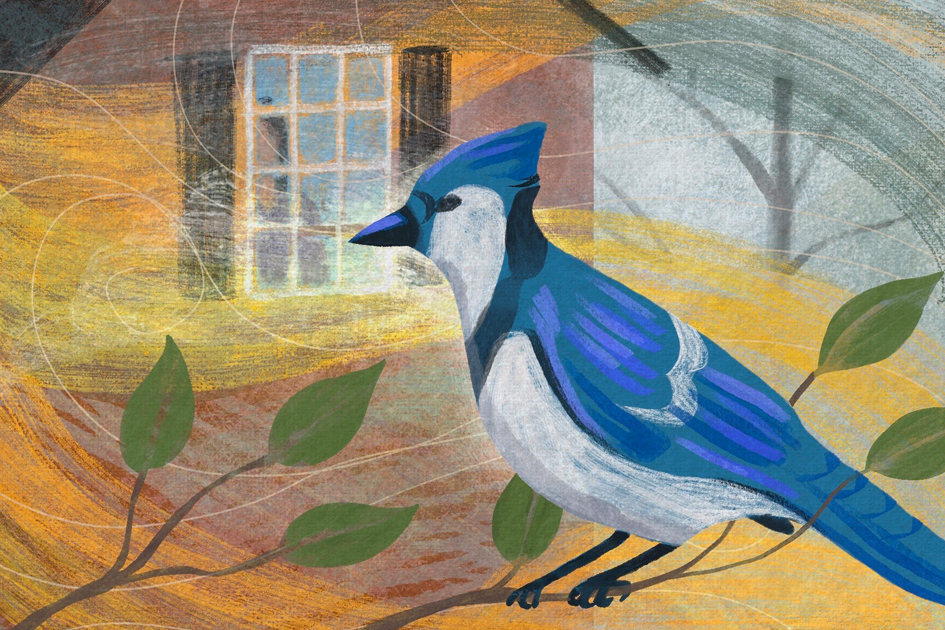 Illustration by Jeff Gregory
By that mild autumn afternoon a few months later, my nerves were frayed. My mind was in an anxious spiral, forever imagining the next bad thing. We had finally sold my dad’s condo, but I worried something would happen to the hundreds of thousands of dollars floating through cyberspace from the buyer’s account to my father’s.
Finally, the notice came in. The wire transfer was successful. For a brief moment, my shoulders unhunched. I heard a bird calling from my kids’ bedroom window down the hall and felt the urgent need to go see it, like this call was specifically for me. Perched on the rooftop, a brilliant blue jay locked eyes with me for a split second and then fluttered away.
It was such a brief encounter, but it shifted my mindset completely. Here was a world right next to mine, entirely removed from my anxious internal one. The sound of that blue jay’s call invited me into a creaturely oasis of the present moment, of sunlight flowing over trees, leaves photosynthesizing, and dandelion seeds floating in the breeze.
Jesus knew the created world was a powerful way to speak to human anxieties. When He gave the Sermon on the Mount to a crowd of dusty, desperate folks on a Galilean mountainside, He told people not to worry about where their next meal would come from or how they would get some shoes for their tired feet. Instead, He directed listeners to “look at the birds of the air” and “see how the flowers of the field grow” (Matt. 6:26; Matt. 6:28 NIV). If even these seemingly insignificant, short-lived plants and animals are provided for in the intricate web of God’s creation, how much more so are we, who are not only God’s creatures but also made in His very image?
We usually read this passage metaphorically, using Jesus’ examples of birds and wildflowers to understand God’s abundant provision for all He’s made. But what if we took Jesus literally here, whenever those waves of anxiety hit? What if, in those moments when all the unknowns leave us unable to take a deep breath or when we don’t know how we will make it through them all, we literally looked at the birds and the flowers out the window? Better yet, what if we stepped outside and joined them with a curious spirit?
Simply spending time in nature, focusing on the way all things hold together perfectly in God’s hands, is always a nurturing experience for the soul. However, there are also more direct lessons to be learned when we examine things more deeply. For instance, a few years ago I attempted to grow some prairie blazing star, a native plant with Dr. Seussian fuzzy purple flowers. Before I could plant the seeds in the ground, I had to do something called “cold stratification.” This involved mixing the seeds in damp earth and placing them in a plastic bag in the fridge for a few months, mimicking what seeds experience in the winter when their hard seed coats are softened by weathering.
The seeds sprouted, but they didn’t survive. Meanwhile, the purple coneflower seeds I had scattered in another part of the yard two or three years earlier came up and flourished. This spring, I thought the black-eyed Susan seedlings I’d planted last year in that same patch had died out, but they miraculously came up again. They must have taken root even while their leaves withered, biding their time for the next season.
When I take Jesus at His word and “see how the flowers of the field grow,” I notice the surprising ways in which the plants know when to come up and when to lie low. By God’s design, even tiny seeds and barely-hanging-on root balls register changing external conditions—moisture levels, temperature, available sunlight, wind patterns—and know when it’s their time.
Likewise, our human bodies, fashioned out of the same earth from which those seeds emerge, know so much that our minds don’t register. Jesus says that our heavenly Father provides for us. Looking to the flowers of the field points us not only to God’s provision of clothing (see Matt. 6:25-34), but to what we know in our flesh and marrow as His creatures: that God is aware of our needs and will see to them in every season of life.
For example, there will be dry seasons as well as rainy ones when it seems to do nothing but pour heartache. Yet we were made for them all. In my current season, I trust that my mom’s body knows how to live and how to die when it is time. Likewise, God has provided each of us—whether we are “care receivers,” “care givers,” or some mix of both—with deep embodied resources to know how to tend to our anxiety, grieve, and move with trust through hard times.
I learned another lesson, this time from a bird. The chickadee weighs less than half an ounce (about the same as a AAA battery), and it survives the season by eating through stashes of seeds painstakingly hidden around its two-mile territory. At the start of winter, the chickadee’s brain grows bigger to accommodate its mental map of tree bark flaps or log cracks—and it will shrink again by the time spring comes and the plants offer up new stores of food.
The chickadee relies on this God-given ability to remember multiple locations where seeds are stored. And the seeds left uneaten grow from the delicate synchrony of water, sunlight, critters, and plant life. Each member of God’s community of creation supports another in mutual flourishing—plants offering seeds, birds carrying them to different places in their beaks and droppings, plant and animal life breaking down into soil with the help of bacteria and fungi, and all the elements creating the right conditions for new sprouts to emerge from the earth.
God has given the chickadee unique abilities in mental mapping and recall. But the chickadee cannot survive by its efforts alone. Every winter morning that the chickadee emerges from its nest is another testament to God’s gift of life to each of us, through the support system of all creation. Likewise, we humans can’t make it by our own efforts. We need each other. We also need all of God’s creation to support our thriving—from the trees that filter air to the insects that pollinate crops.
Observing the simultaneous fragility and resilience of birds opens us up to a different perspective on our personal troubles. More than that, it can also help us recognize how much we as God’s creatures rely on His grace and provision in every moment of our life. So when anxiety comes, we have a choice to make: Give in to it or remember Whose we are. Rather than fall apart, we can take a deep breath. We can look at the flowers and birds. And we can know that, in the presence of our Creator and all He has made, we are never alone.