The women walked together in the dark, their eyes red and achy from weeping. They carried aromatic spices and perfumes, ready to perform one final act of love for their rabbi, who was now in the tomb. They had watched Him suffer and die. And today they came to anoint Him, to say goodbye.
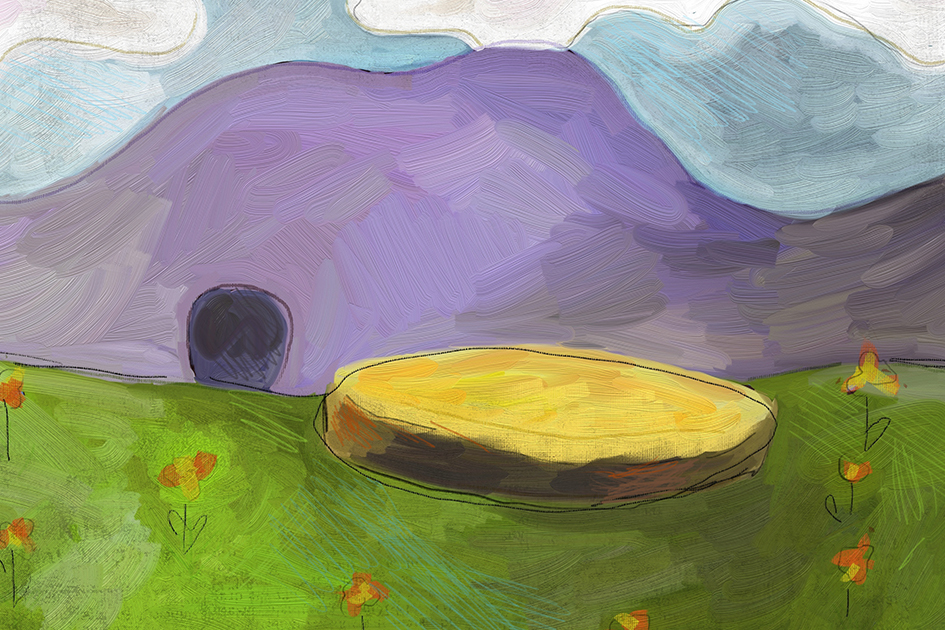 Illustration by Jeff Gregory
But as they approached in the half-light of dawn, they noticed something was off. The massive stone that had sealed the entrance—the one they’d been worrying about, wondering who would roll it away for them—was gone. And there, casually seated on that enormous stone as if it were nothing more than a common bench, sat an angel.
“He is not here,” he told them, “for He has risen” (Matt. 28:6).
The obstacle that had been rolled into place to mark death’s victory, the barrier meant to seal Jesus in the grave forever, had become a seat for the messenger of revolutionary news. This transformation—this moment when the ordinary became extraordinary—established a pattern that continued through the early days after the Resurrection. Over and over, the truth that Jesus defeated death and returned to life imbues the everyday with glory, reshaping the familiar into signposts of the new creation. Things once taken for granted become markers of the new life available in Christ.
Another garden scene unfolded with this same quality of sacred surprise. Mary Magdalene came to the tomb in the fading dark, devotion overcoming her fear. She, too, found the stone rolled away, the tomb empty. In her grief and confusion, she sobbed. Then someone spoke to her: “Woman, why are you weeping? Whom are you seeking?” (John 20:15).
She thought He was only a gardener—and perhaps, in a sense, He was. In this garden of resurrection, Christ was tending the firstfruits of a new humanity, something Mary didn’t yet understand. She pled with the stranger, “Sir, if you have carried Him away, tell me where you have laid Him, and I will take Him away” (John 20:15).
Then Jesus said her name.
It’s a single word—something she’d heard countless times—spoken by a voice she thought she’d never hear again. It became something entirely new: a call from death to life, from mourning to mission. She turned and saw not a gardener but her Teacher. The garden that moments before had been a graveyard became the birthplace of new creation.
This pattern continued at the Sea of Galilee. Despite having seen the risen Lord, Peter returned to what he knew: fishing. The night yielded nothing—only empty nets and the gnawing frustration of familiar failure. But at dawn, a lone figure stood on the shore, one the disciples didn’t recognize in the faint light.
He told them to lower their nets, and when they obeyed, the nets strained under the weight of the catch. In that moment, John recognized the pattern and said, “It is the Lord!” (John 21:7 NIV). That was all Peter needed to hear. He threw himself into the water, swimming toward Jesus with his characteristic impetuousness.
On the beach, Jesus had already prepared a breakfast of fish cooked over a charcoal fire, along with bread. They ate together, and in that simple meal, Jesus began the work of restoration. Three times He asked Peter, “Do you love me?” And three times Peter affirmed his love. The ordinary act of eating together was a site of transformation—reestablishing a once-broken relationship and reconfirming Peter’s calling (John 21:9-17).
But perhaps the most beautiful illustration of this transformational pattern took place on the road to Emmaus. Hearts heavy with grief and confusion, two believers walked away from Jerusalem—seven miles of dusty road stretching before them.
A stranger joined them. He seemed not to know of Jesus’ arrest, trial, and crucifixion. So they explained it all, their voices thick with sadness: “We were hoping that it was He who was going to redeem Israel” (Luke 24:21).
The stranger listened, then began to teach. Starting with Moses and all the prophets, He explained how the Messiah had to suffer these things before entering His glory. They would remember later that their hearts burned within them as He spoke, but still they didn’t fully grasp what was happening.
As they neared the village, they urged the stranger to stay, and He accepted (Luke 24:29). At the table, He took bread, blessed and broke it—and instantly their eyes were opened. They saw Him. They knew Him.
The ordinary meal was a revelation—one that transformed their journey. What had been a retreat became a race back to the city and the disciples, to proclaim, “The Lord has really risen!” (Luke 24:34). But here’s the best part: This transformation process isn’t history, reserved for believers in the early church. The resurrection continues to breathe new life into everything it touches.
Consider the first day of the week. Once simply the day after the Sabbath, unremarkable in the rhythm of Jewish life, it becomes the Lord’s Day, a weekly celebration of resurrection. Every Sunday takes us back to that garden, where death was defeated and new life began.
The same is true of bread and wine. They are the most ordinary of foods, staples of daily life in many cultures. Yet in the hands of a church that follows Jesus’ command to “do this in remembrance of Me,” they become a taste of eternity, God’s new creation breaking into ordinary time. Every celebration of Communion echoes that breakfast on the beach, that supper in the upper room, that meal at Emmaus.
This is the heart of our faith, a truth captured by Paul: “Therefore if anyone is in Christ, he is a new creature; the old things have passed away; behold, new things have come” (2 Cor. 5:17). The resurrection doesn’t simply promise transformation in some distant future but, rather, brings it into the present, infusing the world we inhabit—here and now—with the eternal.
Resurrection faith means nothing in life is too ordinary to be transformed. In Christ, everything has sacred potential. The meals we share become moments of communion. The work we do with our hands, an offering of worship. The difficult conversations we handle with gentleness, the moments we choose patience over frustration, the decision to forgive when it would be easier to hold a grudge—they’re the very moments when the transformational power of Christ’s resurrection is made evident in the world. We need only the eyes to see and the ears to hear, to live each moment in the miraculous light of Easter morning.