I rub my eyes, tired from staring at the screen for hours, and realize it’s past midnight. I need to go to bed. The only thing keeping me from my pillow is a flight of stairs. Groaning at the thought of climbing them yet again, I start a countdown to get myself motivated: Come on. You can do it, David. Three… two… one… go! And as always, my knees chime in somewhere mid-flight to remind me that I’m not in my twenties anymore and this can’t go on forever. So like most people in my phase of life, I’ve started thinking about selling our family’s two-story house.
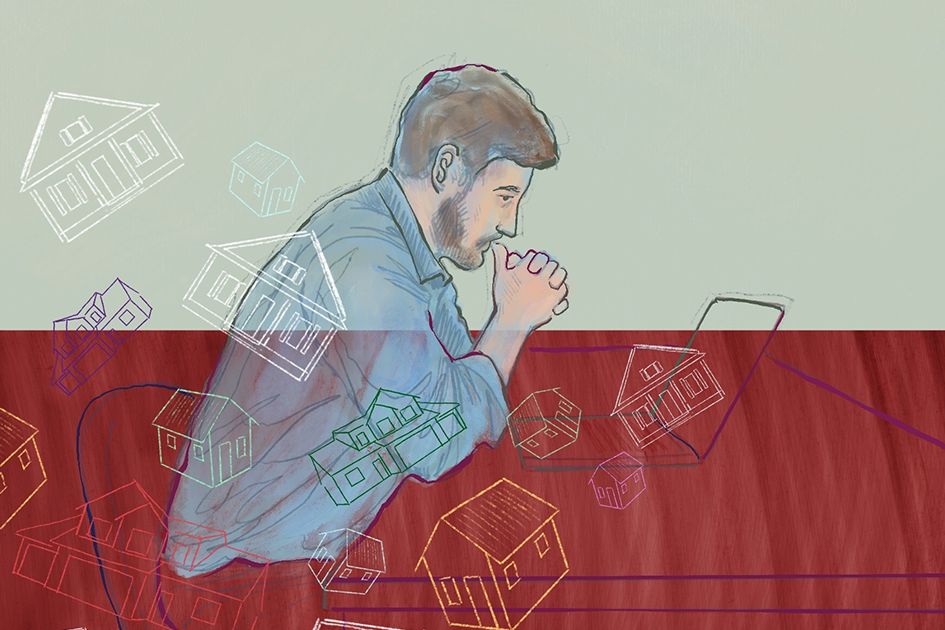 Illustration by Jeff Gregory
I began by casually browsing real estate listings in the area where we want to live. My wife and I had been thinking that downsizing might be in order, and the idea of a simple, uncluttered life was inspiring. But as I continued, things went in a very different direction. It turns out, the internet is not interested in showing us less.
Everywhere I looked, things were popping up that I didn’t know I needed or wanted. I found myself asking, Well, what could a little more money buy? and What would a little more square footage cost? We definitely want mature trees, so how about a bigger yard? Space for a woodshop? Oooh, we could get an outdoor kitchen. Now we’re talking! Before I knew it, my simple wish to be rid of stairs was forgotten amidst the tantalizing thoughts of rain showers, walk-in pantries, and rooms flooded with natural light.
After only a few days, I could feel a knot forming between my eyes and my shoulders growing tighter with each listing I clicked on. I started asking myself, Is downsizing really a good idea? How would that look? I’ve worked hard. Don’t I deserve nice things? I found myself closing my laptop—not with a sense of expectation or satisfaction but overwhelmed by feelings of frustration, anger, and depression. Why is everything so expensive? I wondered. There is nothing out there I can afford that would meet all my needs.
I had to stop looking. I’d love to claim I quit because I immediately sensed the Spirit’s leading or received some deep spiritual insight into the nature of material possessions. But the truth of it is that I was fed up with feeling frustrated and unsatisfied. Dreaming wasn’t fun anymore, and it was hard to type with clenched fists.
I’d gotten caught in a tug-of-war between my initial wish for simplicity and the relentless pull of more. And it dawned on me that I wasn’t looking for houses in a vacuum—my “looking” was being distorted. The algorithms that shape our online searches were cataloging every site I viewed, every link I followed—learning my patterns better than I myself knew them. Advertisers pay big money to learn what appeals to me and then target my desires. It was maddening to realize that my data was being weaponized against my values.
Even though houses—like everything—are certainly expensive these days, the real problem was that I was chasing something that can’t be caught. This data-driven persuasion toward more was creating a very 21st-century form of exhaustion that was robbing me of contentment and the good life God intended.
While our connection to the internet adds a uniquely modern spin, people throughout the ages have been vulnerable to this all-too-human pitfall. Thousands of years ago, the book of Proverbs was offering words of wisdom to help with this struggle: “Give me neither poverty nor riches; feed me with the food that is my portion, that I not be full and deny you and say, ‘Who is the Lord?’ or that I not be in want and steal, and profane the name of my God” (Prov. 30:8-9).
This wise view of life and possessions does not romanticize poverty as some noble path to pleasing God, nor does it claim that riches are the way to the true happiness. It guides us to a middle way in which we honor God by being content purely with having our needs met. When Jesus taught His disciples to pray, He included this same wisdom, saying, “Give us this day our daily bread” (Matt. 6:11). In this well-known verse, Jesus teaches that our true needs are, in fact, modest. When we ask God to sustain us with food and shelter, offering gratitude for those simple gifts helps us maintain a healthy perspective on material things and cultivates contentment.
The idea of finding satisfaction in simplicity, however, feels like swimming against a cultural current. The society we live in seems to insist that we were made for constant, insatiable consumption and that this is normal, possibly even admirable. This impulse is constantly fed by targeted ads for things we don't need, suggested videos for quick fixes, and endless streams of content promising this is the answer that will satisfy our longings or solve our problems.
While it is logical to assume more would eventually lead to enough, it doesn’t seem to work that way. There’s an old joke about a Texas rancher who said he didn’t want all the land in the world, just the land that touches his. This is the cruel irony: Desire dangles contentment before us, promising it’s attainable if we only have this thing. But there will always be a next thing—each one lined up right behind the other on the assembly line of manufactured desires. In the relentless pursuit of more possessions, more achievements, and more comfort, we often discover an unsettling truth: The satisfaction we seek remains perpetually out of reach.
The good news is that this frustrating cycle isn’t our only option. The psalmist claims it is the Lord who gives us what we have been looking for all along: “You will make known to me the path of life; in Your presence is fullness of joy; in Your right hand there are pleasures forever” (Ps. 16:11). And later, “[The Lord] has satisfied the thirsty soul, and the hungry soul He has filled with what is good” (Ps. 107:9).
Contentment can’t be found in what we accumulate or control, only in what we receive as gift. True peace emerges not from abundant belongings but from dwelling in the presence of God. In that sacred space, we discover we already possess everything we truly need—not because of the things we hold, but because of the relationship we have with the One who holds us.